↓
 

Global Traveller Blog

Beyond the Bucket List

  • Home
  • About
  • Featured Images
  • Latest Trip
  • Visiting Sanliurfa
Home - Page 23 << 1 2 … 21 22 23 24 25 … 37 38 >>

Post navigation

← Older posts
Newer posts →

Auschwitz-Birkenau

Global Traveller Blog Posted on June 22, 2014 by JeanneJune 23, 2014

auschwitz

June 13

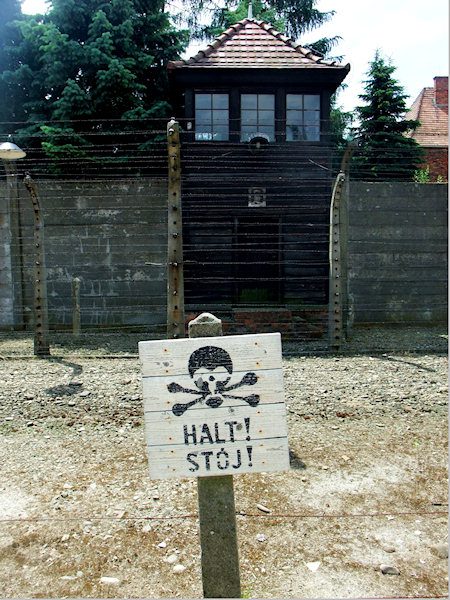
This was a new feeling. What was it? Our guide was sober, restrained. Facts and statistics rolled forth gravely with just the proper emphasis and enlivened by the details she gleaned from survivors’ memoirs. The ugly, squat buildings that contained the unspeakable speckled the flat landscape like fecal matter. The towers with the extinguished spotlights. The barbed wire.

Was it depressing? Not exactly. The New Jersey Turnpike around Elizabeth is depressing. African poverty is depressing. Depression is a numb and blunting hopelessness.

No, the death camps are different. This emotion existed in some space where the  profoundest shock and horror collide and create something new that approaches awe. Awe in the face of massive, unfathomable evil. It’s like traveling to another cosmos of evil. Like the billion-year-old stars flickering above, you knew it was out there someplace, just not in a place you could touch and smell. And then suddenly there it was. Reality.

This place is not a “learning experience”. “And then when I saw a ton of  human hair in a vast case, I realized. . .” Yes, you see the details. “And so many shoes in that case! Childrens” shoes! Fashionable ladies’ shoes of good quality. Did they feel a twinge when ordered to remove these shoes so carefully chosen from the best Budapest shops in order to take their ‘shower’?”.

No, you knew it was bad.  “The horror! The horror!” said Conrad (a Pole, by the way) in Heart of Darkness. You had seen pictures of the train track that ended in a brick wall at Birkenau. From the well-placed photos you could see that  those staggering off the trains knew it was the Last Stop. You knew that the fetid cells and 600 kcal a day diet of Auschwitz’s inmates were the model for the European slave empire Hitler hoped to create.

All this was known.

What was not known was that in treading the ground of Birkenau, the ashes of the dead were clinging to your soles, settling like an accusatory film on the weeds, themselves feeding on the dead. It was not known that touching the bricks and mortar of the barracks, you were touching the DNA of the long-dead prisoners who built them. In what kind of agony did they die? It was not known that you could turn from the much-used firing wall and ponder the last sight of the doomed. Or that the heartbreakingly hopeful drawings by the children still hung on a wall in their dark, cramped quarters.

So go, by all means. Not to learn stuff, not to feel bad, not to check it off a bucket list. View it as a pilgrimage that honors the both the victims of this historic crime and those who prevailed and defeated the perpetrators. It’s not a “Jewish thing”. It’s a profoundly human thing. And a transformative experience.

birkenau

Posted in Poland | Leave a reply

Krakow

Global Traveller Blog Posted on June 22, 2014 by JeanneJune 23, 2014

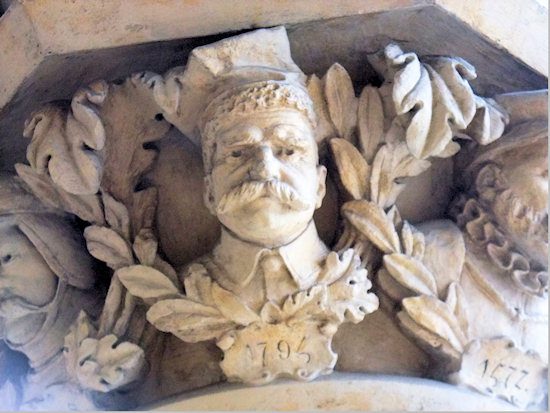
A cabaret owner immortalized in stone sits outside.

A cabaret owner immortalized in stone sits on Krakow’s main square

June 11

Woke up in the Hotel Cristal, Bialystok and enjoyed yet another splendid breakfast buffet replete with fish patés, herring, potato pancakes and more. Diet be damned! I knew it was going to be a long day.

Caught an early train for the day-long trip to Krakow which involved several hours  in Warsaw. Arduous.

Arrived in early evening at the Tulip Hostel where I had booked a twin with private bath. Spacious, cool and super well-located, I wasn’t disappointed. I brushed off the manager who immediately launched into a sales pitch for a tour the following day and headed outside to orient myself and find food.

In a few minutes I entered Krakow’s glorious main square, Rynek Glowny. By that time, the outdoor cafes and restaurants were filling up as evening fell. Even though the architectural details were in shadows, I was entranced by the liveliness and sophistication of the swirling crowds. A jazz quartet drew crowds outside one café in the center of the square while one of the churches advertised a string quartet and a restaurant touted a Chopin concert. I immediately decided that it was the most beautiful and vibrant square in Europe. It is truly Old Europe at its best.

For dinner I ducked into Pod Aniolami descending into the vaulted cellar of this 13th-century establishment where I feasted on cabbage stuffed with kasha and topped with cream. The setting was as traditional as the food. As I was to discover, the medieval facades in and around Rynek Glowny were only part of the story. Wandering inside revealed the high arched ceilings emblematic of the noble residences they once were.

Unlike so many Polish cities, Krakow completely escaped destruction in WWII.  As the former capital of Poland, kings, counts and rich merchants gravitated there to show off their wealth in the form of ever-more elaborate and richly-furnished palaces. Most have been left alone, undefaced by glossy stores or glass-fronted pizza joints. Some of the classic restaurants on the square have been turning out pierogi and roast duck for several centuries.

June 12

I bought a booklet from the tourist office that outlined a walking tour of Krakow’s Old Town along with descriptions of the sights. Again, thanks to James Michener’s Poland, many of the noble names were familiar to me.

The Cloth Hall dominates the center of the square.

krakow-cloth-hallThe wealth of finely-carved ornamentation on the buildings was astounding.

krakow-buildingkrakow-building-detailkrakow-detailIt was hard to tear myself away from the main square. There was so much to look at! But there were other things to see nearby such as the former defensive walls

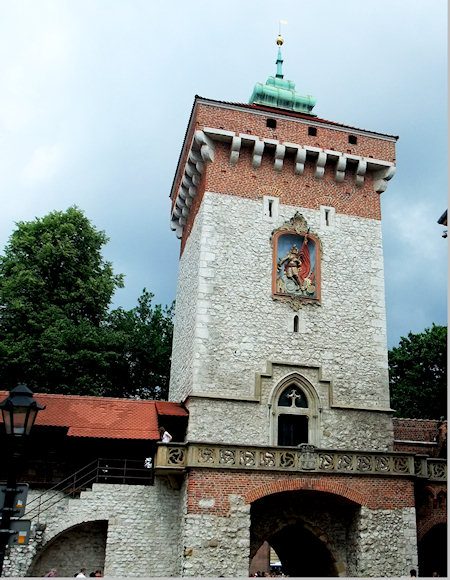
krakow-wallsand St Florian’s Gate

krako-florianJune 13

I had booked a combined tour of Auschwitz-Birkenau in the morning followed by the Salt Mines in the afternoon.

(Read more about the Auschwitz-Birkenau visit here.)

It was around 4 when we finally reached the Salt Mines and the four of us were still in a state of shock following Auschwitz so it wasn’t the best time to appreciate the Salt Mines which is, justifiably, a World Heritage Site.

The salt mines were very much the basis for Krakow’s wealth and had been in operation since the 13th century until 1996. There are some 2350 chambers to visit extending 350m underground. Our guide had a fun and informative spiel that took in the history, methodology and historical importance of the place.

Here is the church:

saltmineCarved out of salt!

carvingThis is where they take kids with asthma:

salt-lakeThe water is at least ten times saltier than the Dead Sea.

 June 14

With no space left in the Tulip Hostel, I changed to the Boutique Aparthotel around the corner and was very pleased. It was managed by a genial Syrian who had fled the fighting there.

After getting settled, I headed to Kazimierz, the former Jewish section and now a neighborhood for artists and alternative types. The weather turned too nasty for a walking tour however so I headed to Wawel, the former seat of power in medieval Poland until the capital moved to Warsaw. It is a vast sprawl of buildings including the mammoth castle and the Krakow Cathedral.

wawelI found it complicated to visit and ultimately disappointing. There are separate admissions for for about five parts of the castle and incorporated museums and some require appointments to keep visitor numbers manageable. I wound up visiting the royal apartments and private apartments but in the first explanations were minimal and the in the second the guide droned on and on. I prefer audiotours to do at my own pace. I would have liked to see more but because of the complicated visiting process that didn’t seem possible. The whole thing needs to be reconsidered.

June 15

Such an interesting day! Yes we’re back to WWII. The tourist office provides a FREE 3-hour walking tour of Krakow’s Jewish Heritage. The tour began in Kazmierz and finished at Schindler’s Factory in Podgorze.

The Kazmierz district has very different architecture from “royal” Krakow. The buildings are modest but tidy, sturdy and well-preserved.

kazmierzAlthough the Jewish community is tiny (now only a few hundred; 65,000 were murdered) there are still historic synagogues in remarkably good shape.

Here is the Isaac Synagogue:

isaacIn central Krakow the restaurants and cafés were elegant and ornate. Here in Kazmierz the vibe was whimsical and bohemian as this one:

kazmierz-cafeMost of Schindler’s List was filmed in Krakow. The harrowing scene where Jews are herded out of the ghetto was filmed here:

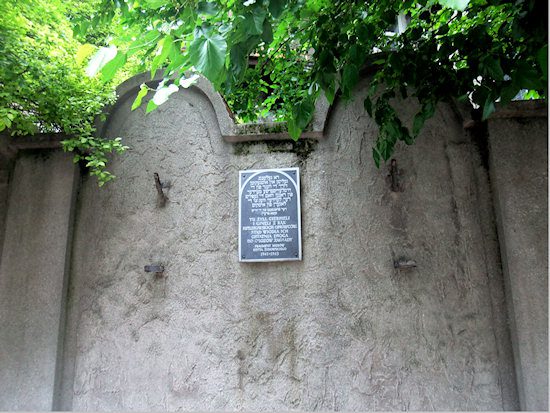
schindlistWe then crossed the river into the Podgorze district, site of the Jewish ghetto. In 1941, the Nazis herded the entire Jewish population of Krakow within these walls.

ghetto-wallOn “Heroes of the Ghetto Square” an imaginative installation commemorates the atrocities that occurred here from transportation of Jews to the concentration camp in nearby Plaszow to murders and mass executions.

hero-squareThe tour ended appropriately enough in Schindler’s Factory, now a fascinating museum devoted to Krakow during the Nazi occupation. There was also a display of the pots and pans produced by the factory although there was surprisingly little devoted to Schindler himself.

It was good to end my trip to Krakow on a high note but I began to think the end came too soon. There’s more to see!

krakow-grafitti

Posted in Poland | Leave a reply

Bialowieza Forest and Park

Global Traveller Blog Posted on June 21, 2014 by JeanneJune 23, 2014

June 7

Got an early start for the three-hour train trip to Bialystok, arriving at the train station around noon to catch the bus for Bialowieza National Park. But where was the bus, or the bus station for that matter? I had a feeling it would be not too far from the train station which proved to be the case. A ticket seller in the train station waved her arms to direct me to the bus station where another ticket seller waved in the direction of the bus which was just boarding.

After discovering that the room I reserved but couldn’t find was operated by a woman who spoke not a single word of English, I blew off the reservation and expanded my budget to include the glorious four-star Hotel Zubrowka  at the edge of the park entrance. Good move!

Bialowieza National Park is part of Bialowieza Forest, the last primeval forest remaining in Europe. The forest extends across the border with Belarus and comprises 370,000 acres. On the Polish side, the forest includes 154,000 acres of which 25,989 is fenced off as a strictly protected reserve and National Park. That area can only be entered with a guide and even with a guide visits are limited to a small area. The forest area is flat  and webbed with a network of hiking and biking trails that weave discreetly through the tall trees and meander outward from small villages.

Here is where the European bison roam! Nearly extinct in 1925, careful management has increased their numbers to around 800. Wise to the murderous ways of humans, bisons keep their distance but do make regular appearances in unpredictable locations.

The forest has remained unmolested because for centuries it was used as hunting grounds for the Polish nobility. The entrance to the National Park lies a few kilometres from my hotel. In between is the Palace Park where a few carefully preserved royal buildings dot the parkland. Although not all the trees are native, it turns out that I saw more birds there than in the National Park. Birds know no boundaries.

Once I got settled, I set about exploring the park on foot.
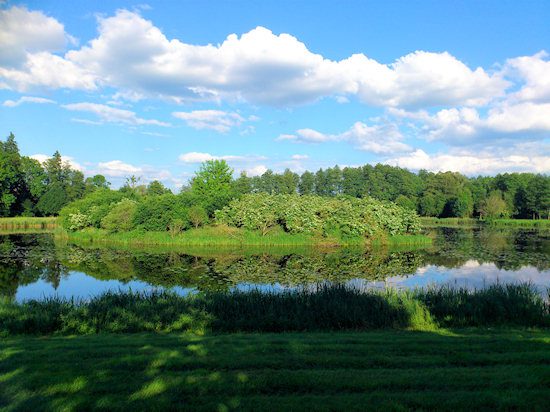
Palace ParkJune 8

In the morning I arranged for an English-speaking guide to enter the National Park. Meanwhile, I rented a bike to explore the Palace Park at leisure. I pedaled slowly up and down the wide lanes noting that the birdsong background was completely different from the soundscape in the Roya valley even though I could not identify the birds. I was pleased that many of the trees were labeled: common oak, large-leafed lime, aspen, silver birch.

Research revealed that the small snake that darted onto my path was a harmless grass snake. I had no problem identifying the mosquitoes which bred happily in the park’s ponds and streams.
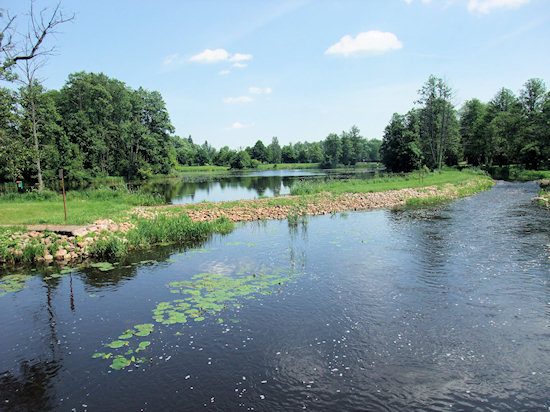
bialowieza-palace-parkWe met Johanna, our guide, at 4pm and set out to the park. Along the way, she was delighted to hear the rare “green warbler“, normally found only in India and only recently spotted in Bialowieza. We also spotted shrike and a red-bellied flycatcher.

I now understand why birdwatchers invariably carry powerful cameras: the birds are so beautiful and the glimpses so fleeting.

Strolling the park, I was awed by the towering size of the trees.
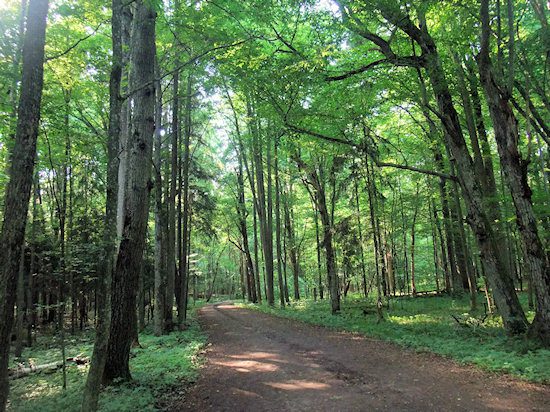
bialowieza-treesDid you expect trackless forest? Sorry but visitors are not allowed to wander about at will.

Fallen trees were everywhere which is a natural and essential part of forest regeneration.
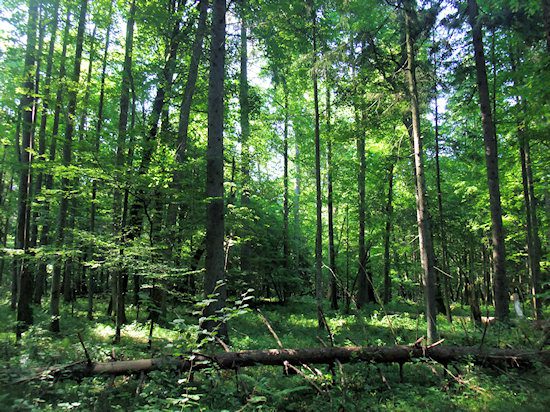
dead-treesThis is the root system of a Norwegian spruce:
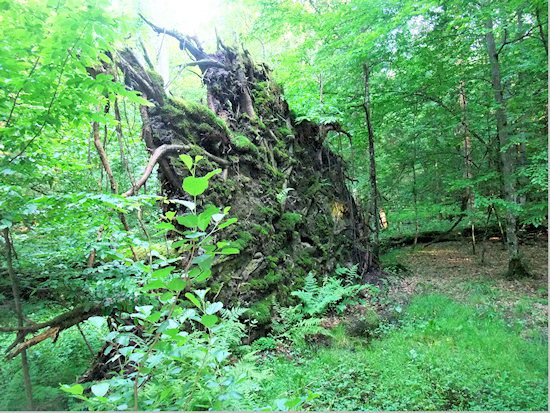
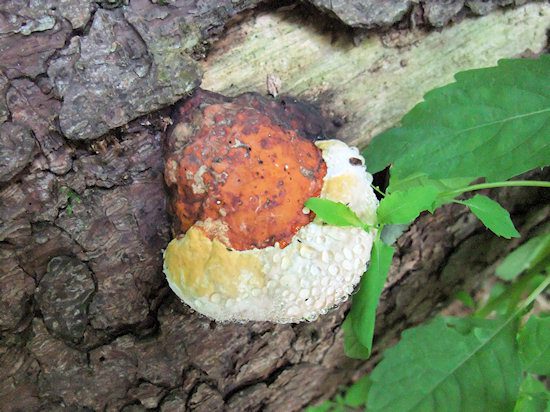
norwegian-spruceThere was also an incredible variety of funghi, some of which were edible.

funghi

more-funghiNaturally, an overwhelming sense of peace and serenity pervaded the forest amid the 40m-high oaks, 50m-high spruce, 32m-high hornbeam and 30m-high silver birch.

bialowieza-nicespot

Outside the protected area and on the way back to the village, we spotted marsh harriers and the rare spotted eagle which makes its home in the park.

June 9

Rousted myself out of bed at 5am when the sun was already up for an hour, I met the guide for a 6am walk. Good bird-watching! We soon spotted a tawny owl hiding in the branches. On the morning walk we saw traces of red deer (but alas no deer) and traces of wild boar as well as an assortment of busy beetles, a toad and a vole. Woodpeckers are highlights of the park and, after much searching, we spotted the famed whiteback woodpecker. More shrike, marsh warblers, blackbirds and finches added to the morning pleasure.

The weather turned rainy in the afternoon and I was glad to avail myself of the hotel’s indoor pool and luxurious spa.

June 10

I had arranged an afternoon departure in order to leave the morning free for more exploration. It was really not enough. Bike trails wind on and on through the forest. I chose a relatively short route to Mlejsce Mocy, otherwise known as the “power spot” or “magic place“. A wide carriage lane led to a turn-off onto a bike path through thick forest and then a clearing. Several large stones are arranged in a sort of circle in the midst of a glade overgrown with oaks, pines and spruces. It’s believed that ancient peoples gathered here in rites to ward off evil spirits.

mlejsceSupposedly the earth emits positive radiation (good vibes?) and subtle vibrations that have healing powers. I don’t know about that. I walked round and round and didn’t feel vibrations but I did have a terrible time pulling myself away from the place. It just felt so good to be there.

A curious thing occurred when I left. I decided to return to the lane and pedal further through the forest. Along I went listening to the birds, enjoying the sunshine. When I shifted into higher gear my bike chain slipped and, with some annoyance, I dismounted to fix it. After that was done, I decided to check the time on my phone. I was horrified to find it reading 13.15. My check out time was 14.00! My bus was at 15.00! I set off for the hotel pedaling like a demon across potholes, swerving to avoid branches, working up a major sweat. When I reached reception, panting, I asked what time it was. “12.40!” Sure enough, I checked my phone and that was the time. Magic? A phone touched by a magnetic field? You decide.

Meanwhile, absorb the happy vibes of the magic place. Or the magic vibes of the happy place?

As I left for an overnight in Bialystok before the morning train to Krakow, I thought I had bungled badly. This place deserves at least a week of exploration. I had only scratched the surface.
Posted in Poland | Leave a reply

Warsaw

Global Traveller Blog Posted on June 20, 2014 by JeanneJune 20, 2014

June 5

Hotel HetmanThe first Pole I met was a rather dour taxi driver who shepherded me to the Hotel Hetman in the Praga district slightly northeast of the town center and across the Vistula river. Are Poles dour, I wondered? That’s the first thing people want to know about any country: are the people friendly? I don’t like to generalize about entire populations but I can note that Poles have not acquired the habit of grinning at strangers even in the “service professions” probably because of years of Communism. Their initial presentation tends to be sober but invariably I found that they responded instantly and warmly to the slightest hint of a smile. As my trip progressed and I was forced to rely on locals to untangle language difficulties and the inevitable travel dilemmas, I found everyone I ran across patient and helpful.

The Hotel Hetman is an elegant Art-Deco style hotel initially built in 1898 when the Praga neighborhood was a lively part of central Warsaw. Bombing at the end of WWII eviscerated historic Praga. Rebuilt in a colorless style, only a few interesting streets remain but the Hotel Hetman was not on one of them. Nevertheless it was safe and only a couple of bus stops away from the Old Town. A self-service buffet across the street was ridiculously cheap and offered a selection of tangy salads involving beets, cabbage, herring, potatoes and corn as well as pierogi.

I was happy to eat and head to bed.

June 6

warsawBefore arriving, I began to read James Michener’s historical novel, Poland, which was a fun way to become acquainted with Poland’s tumultuous and colorful history. It accompanied me throughout the trip I can’t overstate how it deepened my appreciation for the country.

The day started with a light rain as I made my way to Warsaw’s Old Town, bombed to smithereens at the end of WWII and then patiently reconstructed stone by stone. The streets branched off from the main square with the Royal Castle. There were few tourists as I strolled past tiny shops and cosy cafes. The Old Town was small and bohemian but I sensed that Warsavians did their shopping and club-hopping elsewhere.

They did. I took one of the fast and frequent buses up the so-called “Royal Way” lined with  handsome 15th-17th century buildings now turned into high-end shops, restaurants and cafes. I dropped into Specjaly Regionalne for an excellent borscht followed by a spinach salad with strawberries and goat cheese. The server was all “Hi! I’m Luke! I’m your waiter today!”

As elsewhere in the country, the trendiest places were serving pizza and pasta, not Polish food which is a shame because you can do just as much with pierogi as the Italians do with ravioli. In fact, a good pierogi is actually lighter than ravioli.

After lunch it was time for Warsaw’s highlight, the Royal Castle, now an excellent museum. Thanks again to James Michener for familiarizing me with the parade of  Polish kings who lavishly outfitted the castle with Renaissance art and furnishings. Although infested with school groups, there were few other tourists and the audiotour made it possible to explore at my own pace.

royal-catle-warsaw

For those who don’t know, the Polish royalty was immensely wealthy in the 17th and 18th centuries and its kings absorbed the best art and architecture from around Europe. Take a look here. The highlight for me was the Canaletto room with 22 paintings by the Italian master.

Dinner was in an unusual space run for the benefit of an Invalid Association. I was delighted to try the traditional sour soup served inside a bread bowl. This is a concept that deserves elaboration and expansion.

sour-soup

The little shot glass is filled with Soplica, a flavored vodka.

Posted in Poland | Leave a reply

Pas de Colle Ardente, La Brigue

Global Traveller Blog Posted on May 4, 2014 by JeanneMay 4, 2014

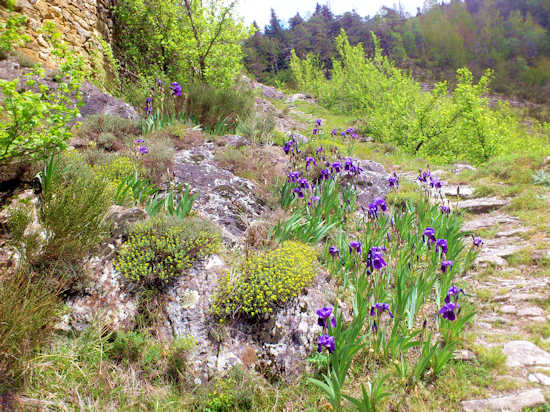
Once again I failed to reach the famous waterfalls Cascade de Fraches on this trail. It’s too hard! I started off at Balise 266 next to the Notre Dame des Fontaines in La Brigue. True I started late (a little after noon) but the trail mounted steeply through schist. It was a beautiful spring day though with everything in bloom.

colle ardente irises

It took me a good 1h 45min to get to this point:

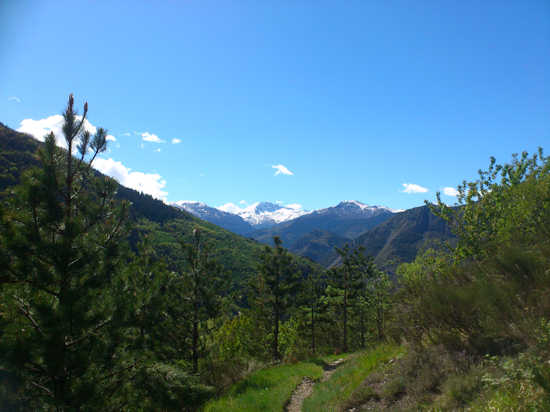
pas de colle ardenteI was huffing and puffing because the rise was steep and relentless. The trail was in good shape though and well-groomed. No flies but plenty of butterflies and lizards. There were few places to rest and the climb was mostly in the sun but with patches of shade. Those are snow-capped mountains in the distance. This was the highest point at about 1336 or maybe 400m denivilé.This was the first point where it was comfortable to stretch out and munch a sandwich. Whew.

After this the trail descended gently and after about 20 minutes or so I could at least hear the waterfalls in the distance. And then I could see them from a distance.

cascadesYes that little crack in the center is a distant stream. Soon after this I turned back. The descent was tricky because of the rocks. Nice views though.

descent

In all, I reached bottom in about four hours. I think that starting earlier it would actually be possible to reach the falls as the trail to them is long but descends gently.


Posted in Roya Valley Hikes | Leave a reply

Post navigation

← Older posts
Newer posts →

CATEGORIES

Amtrak Across America

Arizona

Bangkok

Cambodia

Central Asia

China

Georgia

Greece

Hong Kong

Laos

Malaysia

Morocco

Naples

Poland

Rome-Sardinia

Roya Valley

Sicily

Southeast Asia

Spain

Taiwan

Turkey

Southeast Turkey

Administrative

  • Log in
  • Entries feed
  • Comments feed
  • WordPress.org
©2026 - Global Traveller Blog - Weaver Xtreme Theme
↑