Monday October 1
Although not one of those people who insist on seeing the bright side of every miserable event, in the end my sore ankle gave me a magnificent night under the Sahara stars. I didn’t know that of course when I signed up for a three night four day excursion run by Ando Travel to Morocco’s two main desert gateways: Zagora and Merzougaa. I chose it because it included two nights in two separate desert encampments separated by one night in a hotel. Because the excursion covered about 1500 kilometers, I figured I’d be spending much more time in the minibus than on my feet. After a quick doctor’s visit, some ointment, pills and a cane I was good to go.
One by one my group assembled early Monday morning and by 9am we were heading out of Marrakech in a minibus. About an hour out we were climbing and winding our way up the High Atlas to an altitude of 2200m at the col de tizi n’tichka.
Villages were sparse and there was little cultivation. Great views from Ait Barka:
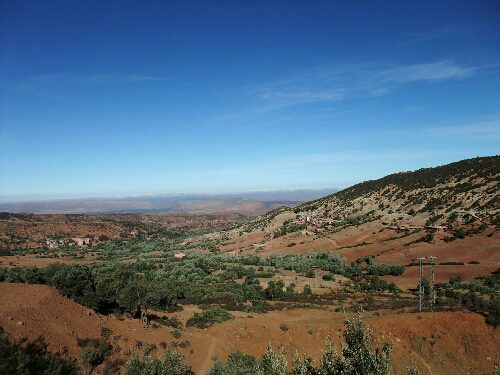
As we climbed higher in the Atlas mountains vegetation was sparse:
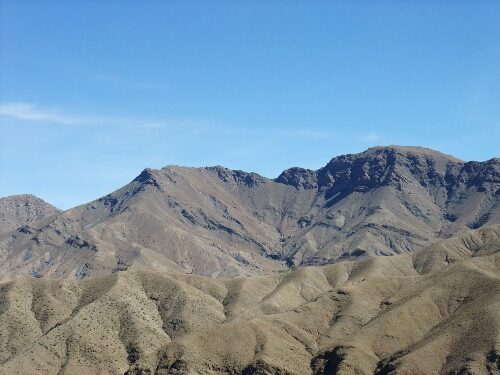
After stopping a few times so the Dutch guy could throw up (it was a really winding road),
 we arrived at Ait Benhaddou, a ksar. From UNESCO’s description: “The ksar, a group of earthen buildings surrounded by high walls, is a traditional pre-Saharan habitat. The houses crowd together within the defensive walls, which are reinforced by corner towers. Ait-Ben-Haddou, in Ouarzazate province, is a striking example of the architecture of southern Morocco.”
 Look familiar? It should. Here are the movies filmed here:
 An old and burnt-out guide in a djellaba escorted us through the kasbah. Rather than climb to the top, I chatted with this artisan who was drawing with a saffron mixture that only became visible when the drawing was held to a fire.
 While waiting for the group he showed me a cellphone video of his 8 year old daughter having a meltdown. Why? School! She didn’t want to leave the comforts of home. BTW, in Morocco primary school education is free; from collége (junior high) parents must pay.
After a rather mediocre chicken tajine for lunch we headed down to Zagora via the stark and imposing Draa Valley.

This forbidding landscape eventually gives way to flat desert with burnt orange villages. Particularly appealing was Agdz with a real desert trading-post feel. By now it was late afternoon and the town was full of action. Berber fashion is much different from the shapeless djallabas of Marrakech. Here the women wore colorful long head scarves with flowing tops and long skirts. Many men, particularly the older ones, wore long robes and turbans.
The road was not crowded. Private vehicles were extremely rare and were probably taxis for tourists. Everyone was either on foot or, if they were young men, on a bike.
After Agdz was a long, long palmerie (palm oasis) that must have extended a good 20km. It was now about 5 and, according to my lp guidebook, we had another 3 to 4 hours until Zagora where we were to climb our camels for a “sunset ride” to our camp. Fortunately the book was wrong and we pulled into Zagora around 7.
Like Agdz, Zagora is a desert outpost but it feels much more like the end of the road. It was once the last stop before Timbuktu. For us, it was the last stop to buy water before heading out to camp. At least one litre per person! We stopped at a little shop to stock up and then drove to the edge of town to meet our camels.
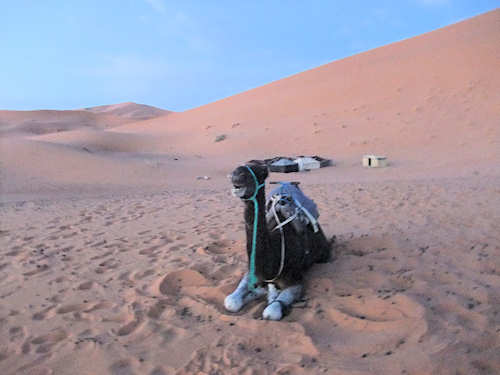
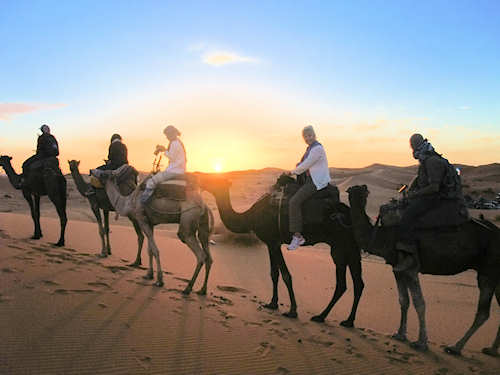
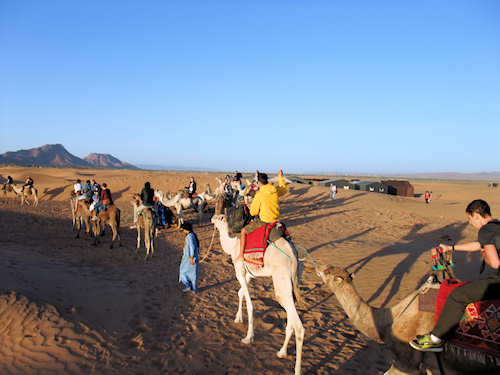
They were all saddled up and kneeling by the time we arrived. It was at about that point I realized I was about to board a camel for a ride of unknown duration to a destination about which I knew little. Oh well. Our blue-robed guides hustled us on board our steeds, took the requisite photos and led us away.

The sunlight was already fading as we started and the sky slowly darkened until we were riding under the stars.. The terrain was sandy and flat with large red rocky dunes rising to our right. The magic was dampened however by incessantly flashing cameras as our young group kept taking pictures of each other. Finally all the pictures were taken and we fell into silence arriving at the camp after about 1 1/2 hours.
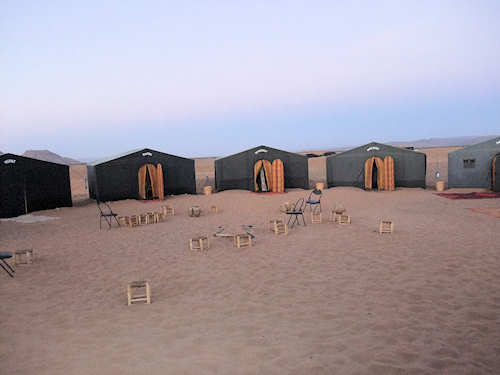
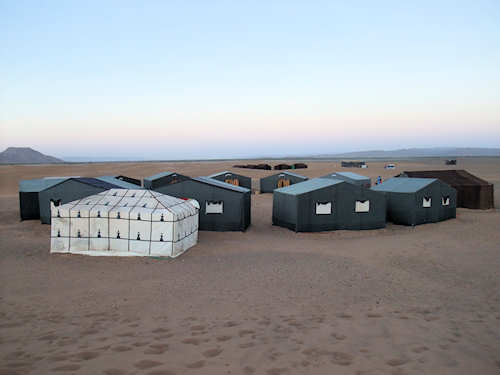
The camp turned out to be relatively luxurious: solar powered electricity and running water from a nearby well. There were even toilets! The weather was perfect; just cool enough to make long sleeves comfortable.
Dinner was inside a large dining tent. It started with lentil soup, followed by chicken and vegetable tajine,finishing with the honeydew melon that seems to be ubiquitous in Morocco this time of year. After dinner we sat in a large circle as some of the Moroccan attendants played bongos and sang some songs.
I wandered outside the circle and presently Mohammed, one of the guides, came out to join me. As we gazed at the blanket of glittering stars, I learned that he came from a nomadic Berber family that was currently camped a seven-day walk away. He was planning to stroll over with some camels in exactly 20 days for a local festival.
They lived in the traditional way, moving on when the sheep and camels had finished grazing the area. Water was not a problem because his ancestors had found springs and dug wells throughout the region. The water was clean but sometimes too salty. They healed themselves in the traditional way. Camel milk has healing powers although the taste is strong, he said. It can cure cancer! Anyway, his people lived long and remained strong until the end. They lived primarily on lamb. As for vegetables, Berbers traded for fresh vegetables and buried them in the sand to dehydrate. When it came time to use them they only needed to soak them in water. Naturally they navigated by the stars at night and slept during the day when they were on the move.
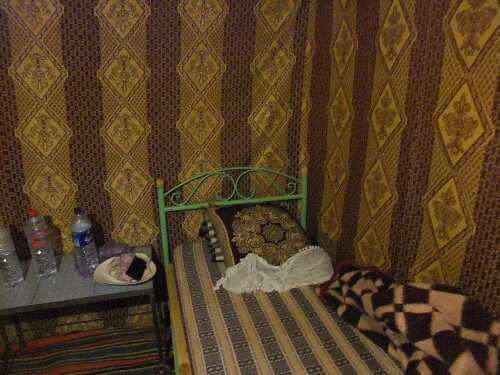
After further starwatching I slipped off to bed, sharing a surprisingly comfortable tent with three other people.
Tuesday October 2
The following morning, our attendants had prepared tea, coffee and bread. We mounted our camels and set off, taking a last look at our camp.

We headed back up the same road, passing village markets, kasbahs and the Palmerie of Agdz.
Ouarzazate is a major center, especially for movies. When film companies weren’t shooting in Ait Hammadou (above) they were down here. Here is the kasbah, although the modern town extends much further.

Although photogenic I didn’t regret that we had no time for a visit. Truth is, I was still a little pooped from our night in the desert.
After meeting my new group, we made a stop in the Rose Valley, named for guess-what that is extensively cultivated here.

The light was already fading by the time we entered the
Dades Gorges.
With the sculptured red walls closing in on either side, it was a strange and slightly claustrophobic landscape.

It was dark when we finally settled into the
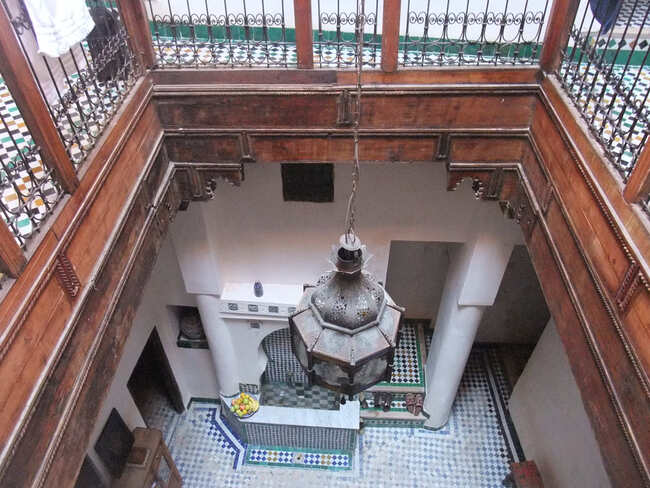
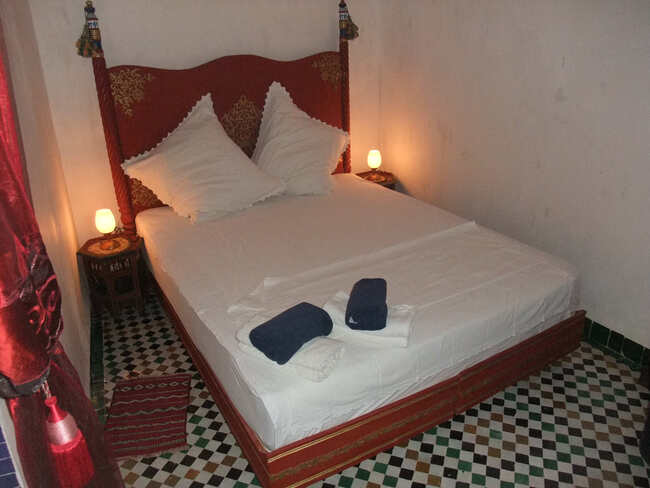
Hotel du Vieux Chateau du Dadès. Take a look! The public areas were attractively furnished with rugs, lamps and Moroccan knick-knacks even if the rooms were somewhat basic. And, after a 10-minute wait, I very much enjoyed my hot shower. Dinner was a convivial experience with a decent enough chicken and vegetable couscous.
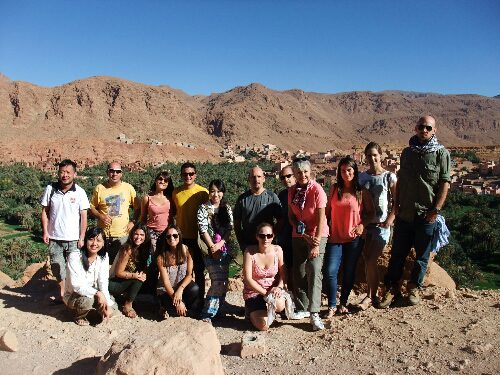
Like the last group, these people were mostly highly-educated professionals in their late twenties and early thirties that hailed from Barcelona, France, Italy, Portugal, Ireland, Japan, and Hong Kong. True to national stereotype the French guy was aloof and unsociable, the Italians were gregarious, the Portuguese were sunny, the Irish talkative and the Japanese polite.
Wednesday October 3
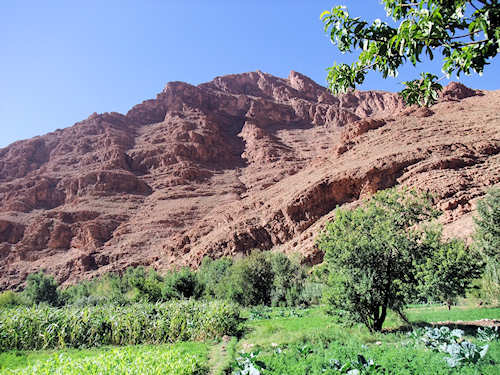
This picture was taken in the Todra gorge which we spent the morning exploring with the help of a guide who took us on a walk through the gorge. This was not particularly helpful for my ankle but I enjoyed his explanations of Berber life in the kasbah. It is a tough and socially-regimented life. You can see many of the older women with small tattoos on their faces. This identifies them as members of a certain family and the same design is often woven into their carpets. Many families prefer to live in a more modern village across the river but the ancient kasbah must be maintained and the government is hurrying to put in electricity, water and other conveniences to encourage the families to remain. Also in the kasbah is a carpet shop! Of course. The salesman was very high-pressure and I only barely escaped carpetless.
Here you can see that modern village in the foreground and the ancient kasbah in the distance.

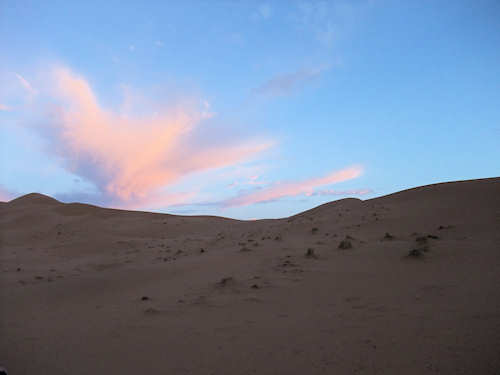
Merzouga was even smaller than Zagora and our camels were already waiting for us. Unlike Zagora, the dunes here, Erg Chebbi, composed a shifting landscape of orange sand. The guides walked quickly making our camels lurch and jolt over the dunes. It was a good workout for my abs! The colors and shapes transported me into a Lawrence-of-Arabia hallucination.

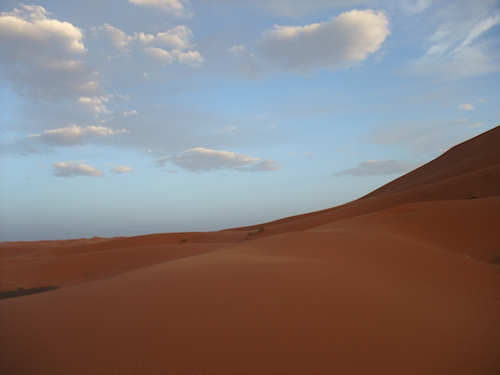
It felt like the middle of the Sahara even though we camped only an hour after embarking at Merzouga. This camp was far more basic than the Zagora camp. There was no electricity or water and only about a half-dozen tents equipped with mattresses, not beds.
After a while, giant tajines of chicken and stewed vegetables appeared which we sopped up with bread. The guide mentioned that after dinner he’d take us on a short walk of about an hour over the dunes. Here is where my sore ankle saved me. Not me! The group gathered themselves and off they went.
I was alone in the Sahara under a billion stars on a moonless night! All was quiet. A soft desert wind caressed my face. I gazed at the Milky Way and thought the usual thoughts (Who am I? Why am I here? Should I change my cellphone plan?)
An hour passed. Two hours passed. I shifted positions to contemplate other star constellations. I began to wonder what I would do if they didn’t come back. No problem. I would take everyone’s water, climb on a camel and head east. Or was it west. My eyes started playing tricks. I thought I saw lights heading down the hill. But no. After 2 1/2 hours I went to bed. Shortly thereafter I heard them all piling into the tents.
And were they pissed off. In the morning I learned that the hike was far, far more arduous than they had thought. The guide had to haul some of the young women by hand up the dunes. They were falling asleep in their tracks. As one of the Portuguese women explained it, “We came to feel like we were in the middle of nowhere but when we got to the top of the dune we saw light from a village that was really not so far off. It ruined the whole thing.”
I think it was a macho thing for the guides. “See we’re not like these girly-men Europeans. We’re Berbers!”
Thursday October 3
We were up before sunrise and hopped on our camels for a ride to Merzouga as the sun lit up the dunes.
It was a good 10-hour drive back to Marrakech without any scenic stops or visits except for lunch an tea breaks. Everyone was pretty much wiped out from the dune hike, except me. Thanks to my ankle.